The 1920s saw the emergence of the avant-garde Surrealist movement. The Surrealists, as outlined in the Manifesto of Surrealism written by Andre Breton in 1924, sought to explore the unconscious mind through dreamlike imagery. Women played a central yet complex role in the Surrealist art movement. The women featured were often reduced down to a form of iconography: muses, objects of desire, or symbols of the male subconscious. Women and the female form were a central image in the movement. The male Surrealists, conformed to the social sexualisation and dissection of the female form under patriarchal view of female agency, described by the theorist Laura Mulvey in The Male Gaze. Contrastingly, the female artists within the movement used Surrealist techniques to reclaim their own representation, asserting agency and autonomy. It is the differentiation in the gendered perspective view of the female form in surrealism that defines women’s representation in the movement. Surrealist imagery centralising women both reinforced and challenged traditional gender roles. Thus, revealing the underlying tensions between male fantasy and female empowerment within not only the surrealist movement but the art world at large.
The depiction of women in male Surrealist art often reinforced patriarchal fantasies, reducing women to passive objects of male desire. This is particularly evident in the works of Hans Bellmer and André Breton, who positioned women as either fragmented, fetishized objects or elusive, idealized muses. These representations draw heavily from Sigmund Freud’s psychoanalytic theories, particularly his views on femininity, hysteria, and the unconscious. Freud theorized that women were defined by lack, a concept rooted in his theory of “penis envy,” which suggests that female identity is constructed in relation to male desire rather than possessing autonomous meaning. This notion contributed to the Surrealist tendency to depict women as incomplete, fragmented, or unknowable, reinforcing their status as projections of male fantasy rather than independent beings.

Hans Bellmer, The Doll (La Poupée), 1936
Hans Bellmer’s The Doll (La Poupée) exemplifies this Freudian framework, as his reconfigured mannequins present the female form as a site of male manipulation. His grotesquely distorted female figures reflect Freud’s theory of the “uncanny” (Das Unheimliche), where something familiar—such as the human body—becomes unsettling when distorted or fragmented. Freud describes the uncanny as “that class of the frightening which leads back to what is known of old and long familiar”. Bellmer’s dolls evoke both desire and horror, reinforcing the Surrealist fascination with the subconscious while also illustrating Freud’s argument that female sexuality is mysterious, threatening, and fundamentally Other. This aligns with André Breton’s assertion in The Surrealist Manifesto (1924) that “the marvelous is always beautiful, anything marvelous is beautiful, in fact only the marvelous is beautiful.” The Surrealists’ fascination with the marvelous often manifested in depictions of women as dreamlike, unattainable figures, reinforcing their role as muses rather than active participants in the creative process.

André Breton, Nadja, 1928
Similarly, in André Breton’s novel Nadja the titular female character is portrayed as an enigmatic muse, embodying Surrealist ideals of irrationality and spontaneity. Freud’s concept of hysteria is particularly relevant here, as Nadja’s mental instability is depicted as both alluring and troubling. In Freudian psychoanalysis, hysteria was historically associated with women and linked to unconscious repression, reinforcing the idea that female identity is intrinsically tied to emotional excess and irrationality. Breton’s depiction of Nadja as an almost supernatural figure who ultimately succumbs to madness aligns with this tradition. His abandonment of Nadja at the novel’s end reflects the patriarchal tendency to romanticize female instability while ultimately dismissing or discarding women who fail to conform to male expectations. Simone de Beauvoir’s later critiques that woman are ‘perpetually defined in relation to man’.⁶ As Mulvey argues in Visual Pleasure and Narrative Cinema, women in patriarchal narratives are often either fetishized or punished—either transformed into objects of desire or relegated to the margins when they cease to serve male fantasy.
Breton’s views on women are further illuminated in his essay What is Surrealism?, in which he describes the femme-enfant, a woman who embodies innocence, irrationality, and the marvelous. He states, “She alone guides my steps, her eyes alone are capable of maintaining mine in a light that is unique to her.” This idealization of women as mysterious, almost mystical beings aligns with Freud’s characterization of femininity as enigmatic and unknowable. Freud, in Femininity (1933), argues that “the sexual life of adult women is a ‘dark continent’ for psychology,” reinforcing the notion that female identity is an obscure and inaccessible realm. The Surrealists, rather than challenging this patriarchal construction, often embraced and exaggerated it, further relegating women to the role of the unknowable Other.

Man Ray (Emmanuel Radnitzky), Le Retour à la raison, 1923
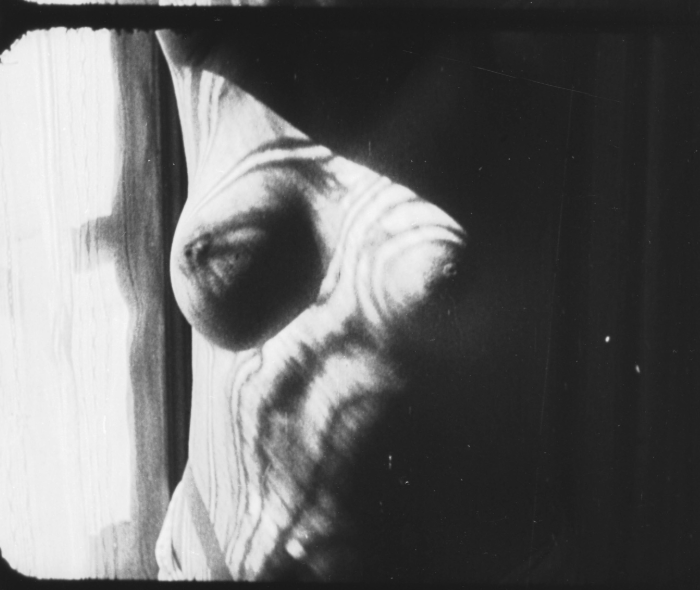
Man Ray’s Veiled Erotic similarly reflects this Surrealist fascination with the female body as both revealed and concealed, available yet inaccessible. His photography often centralises around the nude female form seemingly under sheer veils embodies the duality of exposure and mystery. This aligns with Freud’s idea of scopophilia—the pleasure in looking—where the female body becomes the passive object of the male gaze. In Three Essays on the Theory of Sexuality (1905), Freud discusses the role of fetishism in male desire, suggesting that the fetishized female body parts become substitutes for the feared “lack” of the phallus. Surrealist depictions of fragmented female forms, as seen in Bellmer’s work and Man Ray’s eroticized photography, can be interpreted through this Freudian lens as an attempt to displace male anxiety about castration onto the female body, further stripping women of agency.
While Surrealism aimed to liberate the unconscious from societal constraints, its male members frequently reinforced conventional gender hierarchies rather than subverting them. As Simone de Beauvoir critiques in The Second Sex (1949), “woman is defined and differentiated with reference to man and not he with reference to her; she is the incidental, the inessential as opposed to the essential.” The Surrealist tradition of depicting women as muses rather than autonomous agents exemplifies this notion, as female identity is often shaped solely through its relationship to male creativity.
Surrealist art has often been criticized for its objectification of women, yet many female Surrealists actively resisted this trend by reclaiming their bodies, identities, and narratives. Unlike male Surrealists, who frequently reduced women to muses or fetishized figures, female artists used Surrealist techniques to explore selfhood, gender, and psychological depth. This shift is evident in Que me veux-tu? by Claude Cahun, Meshes of the Afternoon (1943) by Maya Deren, Assia by Dora Maar, and Self-Portrait on the Borderline Between Mexico and the United States (1932) by Frida Kahlo. These works challenge traditional representations of women by asserting female subjectivity, agency, and fluid identities. The Female Surrealist artists actively resisted objectification and instead used Surrealist techniques to explore selfhood, gender, and psychological depth challenging traditional representations of women by asserting female subjectivity, agency, and fluid identities.
The male Surrealists often imagined women as muses, symbols of madness, or eroticized objects, female Surrealist artists turned the tools of the movement inward, using Surrealism’s emphasis on dreams, the unconscious, and irrationality to explore identity, psychological trauma, and gender politics. These women did not merely participate in the movement—they transformed it, bringing a radical subjectivity to the representation of women.

Claude Cahun, Que me veux-tu? (“What do you want from me?”), 1928
Claude Cahun’s self-portrait Que me veux-tu? (“What do you want from me?”) embodies Surrealism’s fascination with the shifting nature of identity but subverts its traditional portrayal of women. Unlike male Surrealists, who fixated on women as objects of desire, Cahun deconstructs gender itself. With an androgynous appearance and direct gaze, the photograph challenges the idea of a fixed, knowable self. Their work predates and anticipates Judith Butler’s theory of gender performativity. Butler argues in Gender Trouble (1990) that “gender is a kind of imitation for which there is no original,” and Cahun’s images—marked by fluidity, androgyny, and theatricality—embody this idea. Through costuming, roleplay, and direct confrontation with the viewer, Cahun refuses categorization. The repeated question of the title—“What do you want from me?”—turns the male gaze back on itself, implicating the viewer in their own projections and desires. This defiance deconstructs the idea of woman as muse, offering instead a self-aware subject who performs identity rather than inhabiting it passively.

Maya Deren, Meshes of the Afternoon, 1943
Similarly, Maya Deren’s film Meshes of the Afternoon (1943) is a foundational feminist reworking of Surrealist tropes. Where male Surrealists use dream logic to explore male fantasy, Deren uses it to map the fragmented nature of female consciousness and subjectivity. Deren stars in her own film, repeating scenes of domestic entrapment and emotional breakdown, suggesting the cyclical nature of patriarchal repression. The use of doubling, mirrors, and the faceless cloaked figure reflects Freud’s notion of the uncanny (das Unheimliche), but here it is not used to eroticize or mystify the woman—it externalizes the female internal states of anxiety and alienation. Deren reclaims the dreamscape not as a place of male fantasy. Her film prefigures the kind of “counter-cinema” advocated by Laura Mulvey, which resists traditional narrative control and voyeuristic structures, creating space for a woman’s psychological truth.

Dora Maar, Assia, 1934
Dora Maar, both muse and maker, rejected the passive role often ascribed to her by male contemporaries like Picasso. Her photograph Assia is striking in its departure from the objectified nude. Through stark contrasts and careful framing, Maar renders the female body not as erotic display but as a monument of strength and dignity. Assia’s presence is neither fragmented like Bellmer’s dolls nor veiled like Oppenheim in Man Ray’s photos—she is whole, powerful, and in control. This visual assertion corresponds with Simone de Beauvoir’s argument in The Second Sex that “one is not born, but rather becomes, a woman,” a statement that underscores the performative and constructed nature of femininity. In taking the camera and reframing the female form on her own terms, Maar enacts the becoming of woman as a subject, not a spectacle.

Frida Kahlo, Self-Portrait on the Borderline Between Mexico and the United States, (1932)
Frida Kahlo represents perhaps the most explicit political reappropriation of Surrealist aesthetics. Though she famously remarked, “They thought I was a Surrealist, but I wasn’t. I never painted dreams. I painted my own reality”. Her work shares the movement’s visual symbolism and dreamlike intensity. In Self-Portrait on the Borderline Between Mexico and the United States (1932), Kahlo presents herself not as a muse but as a border-crosser—between nations, identities, and histories. The painting contrasts industrial America with lush, ancient Mexico, situating her female body at the center of cultural, historical, and gendered discourse. Her direct gaze, traditional Tehuana dress, and symbolic rendering of nature and industry signal her political and personal resistance. She asserts control over her representation and uses her body as a site of cultural critique and resilience, especially in the face of colonialism and patriarchy. This politicized self-portrait challenges both Western artistic traditions and the Surrealist tendency to universalize the unconscious without accounting for race, class, or colonization.
Unlike the male Surrealists who often cast women as objects of desire or muses of the unconscious, Cahun, Deren, Maar, and Kahlo actively deconstructed these roles. Cahun challenged gender norms, Deren explored female subjectivity and psychological depth, Maar framed the female body with strength rather than fetishism, and Kahlo reclaimed narrative control over her own body and cultural identity. These artists used Surrealist techniques—dream logic, symbolic imagery, and fragmentation—not to reinforce patriarchal fantasies but to explore personal, political, and gendered experiences. Their work highlights a key contradiction in Surrealism: while the movement sought to break free from rational constraints, its male members often reinforced conventional gender hierarchies. The female Surrealists, however, turned Surrealist methods inward, using them to dismantle oppressive representations and forge new, self-determined identities. By reclaiming representation, female Surrealists not only disrupted the male gaze but also expanded the possibilities of Surrealist expression.
 Swan Soul Stories
Leave a comment