Author: tesshardy

  • TOYS: THE HISTORY OF THE GOOD VIBRATIONS

    TOYS: THE HISTORY OF THE GOOD VIBRATIONS

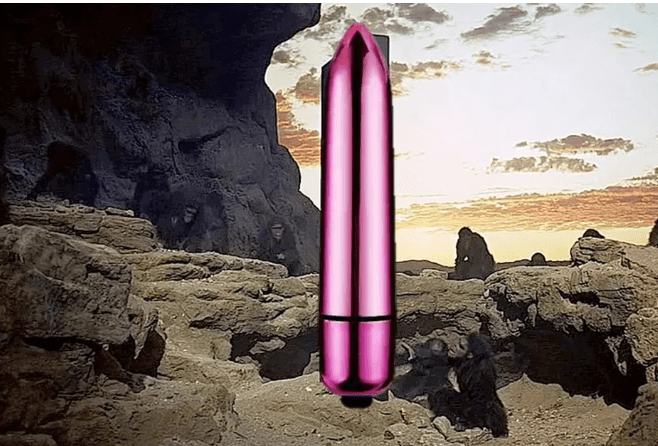
    Since the dawn of humanity, the Cambrian explosion wasn’t the only evolutionary burst of life to report. As we explored the world around us, we quickly began to utilise it to bring us closer to sexual gratification. The history of sex toys reaches much further back in time than the utilisation of technology in our never-ending quest for stimulation. From Victorian-era steam-powered dildos to hand-cracked vibration devices, and the famous Hitachi Magic Wand to the more modern devices with Bluetooth control leaving a throbbing memory. Who would have thought a little pink bullet could possess years of breathtaking lore, while also being a symbol of the politics of female sexuality and the perpetrator of good vibrations.

    This stimulating history stretches back 30,000 years to the Palaeolithic period. A siltstone phallus was found in Germany and is said to date back 28,000 years, making it the oldest known ‘sex toy’ ever discovered. Our Palaeolithic pals really got creative with it. Phalluses made from stone, wood, leather, and even camel dung have all been found during excavations. The Egyptians and the Greeks used unripe bananas, or animal dung coated in resin as sexual aids believing them to be aphrodisiacs, a substance alleged to increase libido. 

    Some say that the Egyptian queen Cleopatra invented the first vibrator in history. She had the idea of filling a box with bees (no mid-wank-battery-dying for her – simply shake and go) and the violent buzzing caused the box to vibrate and then… Well, the rest is history. Cleopatra’s saucy secret gave a new meaning to the status of “queen bee”, and she really put those bees to work. Despite her box remaining shrouded in mystery, Cleo nonetheless remains an Empire-ruling, pearl-eating, vibrator-creating Baddie. 

    RIP Cleopatra, you would have loved Sexyy Red and LoveHoney.com. 

    In ancient Greece, traders in the city of Miletus reported the making and selling of objects called ‘olisbos’, created to help wives achieve sexual penetration while their husbands were away. Nowadays, for a mere £40 you can ‘Clone a Willy’ for your night-time itches (I wonder what the rate of inflation for such devices is). History has proven that absence makes the pussy grow horny, I guess women never change.

    These types of aids were also used in Renaissance Italy, typically made of leather and doused in olive oil for lubrication. High class members of society would even display their sex toys, often made from silver, gold, and ivory. Picture this: you walk into your neighbours house and compliment them on their ‘ever-so-thrilling’ mantle piece adorned with metal appendices in the place of flowers or candles. 

    The first dildos didn’t arrive in the UK until the 1500s. The term dildo was first coined in around 1400 AD and originated from the Latin for ‘dilatare’, meaning ‘open wide’. Up until the 1920s, vibrators were used among physicians to ‘massage’ female patients into an orgasm in order to treat them of ‘hysteria’. A devastating, life-threatening, earth-shattering condition that has been recently denominated, 

    drumroll please…

    ‘Female pleasure’: an ailment considered both common and chronic among women. 

    Enter: Dr. Macaura’s ‘Pulsocon Hand Crank’ from 1890 (the name alone is as scary as an angry beehive). Apart from being hand-cranked, the mechanics and effectiveness of this Victorian Era device are unknown, and I, personally, am content with such ignorance.‘The Manipulator’ (I know) was another vibrating Victorian favourite, and this steam powered beast was apparently as powerful as it was noisy. 

    ‘Honey, what’s taking so long in the bathroom?’

    Full steam-spunking power from Level One to Eleven.

    In 1970 there were fanny-flutters all round as the famous Hitachi Magic Wand entered the market. An MVP in the sex toy world, the GOAT, the Micheal Jordan. Sex Toy Experts say that it is, still to this day, the best plugged vibrator in existence. Imagine 110 volts of alternating currents being transformed into a massive rotating and vibrating power ball of pleasure. 

    What is pink, nine-inches long, twirls, flutters and vibrates, and is known for its disarmingly cute bunny ears? ‘The Rabbit’. This vibrator catapulted to fame 20 years ago when it featured on Sex and the City. It became a pop culture sensation and Kim Kattrell single handedly ushered in a new era of sexual consumerism. Thank you Samatha Jones, we are eternally grateful to you. For the first time, female shoppers boldly strutted into sex-toy stores. ‘The Rabbit’ became an instant classic and Sex and the City took vibrators out of the shadows. No need to be plugged in; just a couple of triple AA’s and lift off! 

    Nowadays, the sex toy represents autonomy and allows for self-exploration. They are a pink, jiggling symbol of liberation, particularly for women, given the turbulent history of the shaming of female sexuality. The androcentrism of sexuality and typical heterosexual intercourse has created a vast orgasm gap: the marked difference in the frequency of orgasm between cisgender men and women in intercourse. This has pushed women into finding their own pleasure, and toys lend a buzzing helping hand (or member). Post COVID, like Renaissance Italians, we are embracing a new age of sexual pride in our toys. When showing ‘What’s in my bag’ to British Vogue, Emma Corin nonchalantly whips out a little pink lipstick-looking gadget and plainly states ‘my vibrator’. Charlotte York gleefully explained their charming significance: “Oh, it’s so cute! I thought it would be scary and weird, but it isn’t. It’s pink! For girls!”. 

    As of a 2021 report by strategy&, the global sexual wellness market is estimated to be worth over $19 billion. The market (rather unsurprisingly) grew by 36.8% over COVID-19 and the forecast for the market is to keep thrusting forward by 7% annually. The popularity of vibrators and dildos has endured since the Roman era, as they account for  27% and 25% of the global market In the UK. You can buy them online at ASOS, Urban outfitters, or Boots to be delivered right to your doorstep (thank me later). 

    Gone are the times for a painful and humiliating trip to Ann Summers and cluelessly buying the first thing you see in an attempt to be in and out as quickly as possible. Now, just one click and bzzzzzzz… bring on the Good Vibrations!

    https://www.asos.com/women/face-body/wellness/cat/?cid=50072 (treat yourself!)

    https://www.forbes.com/sites/lynncomella/2018/08/07/20-years-later-how-the-sex-and-the-city-vibrator-episode-created-a-lasting-buzz/?sh=7e5295cb649b 
    https://www.theguardian.com/lifeandstyle/2012/sep/07/how-the-vibrator-caused-buzz
  • UNCREDITED GENIUS: STOLEN SUCCESS IN STEM

    UNCREDITED GENIUS: STOLEN SUCCESS IN STEM

    The prosperity, innovation and advancements in Science, Technology, Engineering and Maths or STEM, is recognised by annual award ceremonies most notably the Nobel Prize. There have been 346 Nobel Prizes awarded in the Science Categories: Physics, Chemistry and Medicine or Physiology.

    26 to Women. 320 to Men. 

    The world of “STEM” has an infamous reputation coded in sexism and misogyny, the discoveries of women have been the backbone of scientific development. The prize winners (a common motif within the prominent figures of life) are most often old, cis white men. The voices of generations of women are callously silenced and their successes snubbed. Their intellectual property and groundbreaking discoveries that have changed the course of history have been stolen entirely. Examples of  outright theft: discoveries plucked from the hands of our legendary ladies and credit passed on to the white man in his white coat.

    What do these all have in common?   

    • The structure of DNA
    • Nuclear Fission 
    • The Cure for Leprosy
    • The development of electronic frequencies.

    No, it’s not that they are some of the most groundbreaking scientific discoveries that have been made.

    They were all discoveries made by women, and stolen from them. 

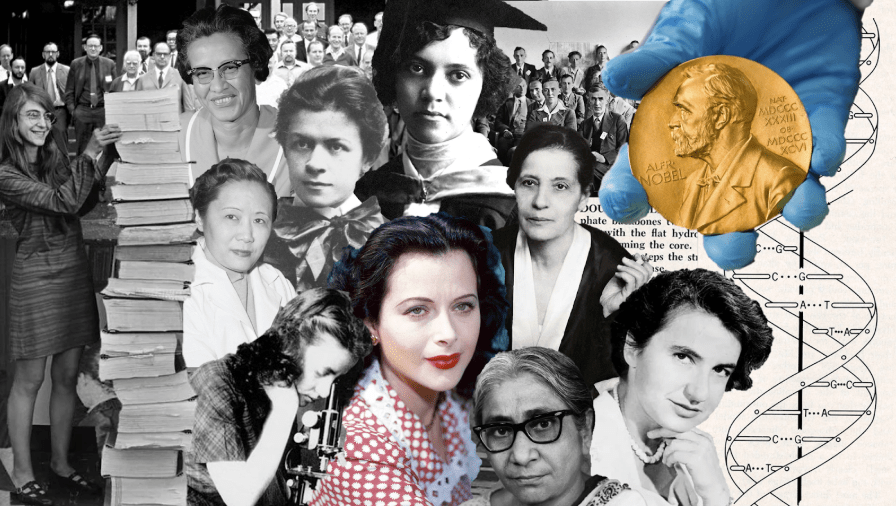
    Rosalind Franklin is the uncredited discoverer of the double helix structure of  DNA. Franklin was fierce and, according to her fellow (male) scientists, ‘short tempered and stubborn’. So much so that they claimed to find working with her to be a ‘challenge’. 

    Oh Franklin, you would have loved DIVA by Beyonce. Franklin, you have been the number one diva in this game for a minute.

    She worked alongside Maurice Wilkins and Francis Crick. Franklin had immediate beef with Wilkins; their conflicts leading them to work in relative isolation. Unknown to Franklin, Watson and Crick were right nosey nannies and read some of her unpublished data, including the beautiful “Photograph 51“.  Photograph 51 is treated as the philosopher’s stone of molecular biology, the key to the “secret of life” . Using Franklin’s photograph, Watson and Crick created their famous DNA model. Franklin’s contribution was not acknowledged, and in 1962 Crick and Watson won the Nobel Prize for Physiology. Franklin had died from ovarian cancer 4 years prior to this. She wasn’t mentioned once, leaving her as the wronged heroine of DNA. 

    Dr Lisa Meitner was the Queen of Physics. She was one of the first women to earn a doctorate from the University of Vienna but fled after Austria was annexed by Germany in 1938. She moved to Sweden and began researching with her partner Otto Hahn (WARNING: MASSIVE ARSEHOLE). Meitner discovered nuclear fission, one of the most groundbreaking scientific discoveries made in history thus far. When publishing their research, Hahn conveniently left off mention of Meitner’s name. In 1944 he was awarded the Nobel Prize for Chemistry and Meitner wasn’t mentioned once. In 1992, element 109 was named Meitnerium (Mt) in her honour. Many consider Lise Meitner the “most significant woman scientist of the 20th Century”.

    Dr Alice Ball was the first woman and black American to get a PhD from the University of Hawai’i. She was also the first black chemistry professor. Big slay. She found the cure for leprosy, ‘The Ball Method’. Ball chemically modified Chaulmoogra oil to become water soluble to be absorbed by the body. Unforntionally, Ball died at only 24 years old. But her story doesn’t end there.. Her advisor Arthur Dean (I think you know where this is going) continued the trials of her treatment. Dean published a method of extracting the active ingredient in chaulmoogra oil without acknowledging the research by Ball. It was known as the ‘Dean Method’. 

    Hedy Lamarr was an actress turned inventor. She was a sexy scientist spy. Girlboss. She created a secret radio system that could frequency hop during WW2. She presented this invention to the Navy, but after claiming they didn’t want Lamarr’s technology they stole it for themselves. Lamarr’s work is with us everyday, she birthed Wi-Fi, GPS and Bluetooth. She is Mother. 

    So, Women have always been in STEM, and  always will be. Even if forgotten, unacknowledged, robbed or  ridiculed – women in STEM prosper whether we see them or not. Misogyny is grounded deep within the foundations of every aspect of modern society, with intellectual property ownership in STEM being no different. I want to highlight this theft of success, do we not owe that to these women? To amplify the voices of those affected by cruelty of men in hope of fostering a more equitable and inclusive community within science and engineering. I believe that is the true meaning of strength, to fly in the face of ignorance and continue on for the betterment of humanity. 

    So, this is my love letter to all women who have been or are in STEM.

    We see you and appreciate you.

  • BYTE BACK: NAVIGATING THE CYBER RACE

    BYTE BACK: NAVIGATING THE CYBER RACE

    In October of last year, the British Library fell victim to a cyber-attack and user data was stolen, harvested, and auctioned off on the dark web for a starting price of £600,000. The library refused to pay and was left with no WiFi, no computer access, no website, and no phone lines, and they are still grappling with the waves of consequence. The hacker gang Rhysida is thought to be behind the attack: a ransomware-as-a-service group, meaning clients pay for the group to target a victim of their choice. The attack highlights a new vulnerability that many of us have never acknowledged: our data. 

    Gradually, the value of online data collection has become a trillion-dollar-a-year industry. While the global oil market was worth about $1.7 trillion in 2019, the following year left this figure eclipsed by the global data market which valued at about $3 trillion in 2020. As the world moves online, our data becomes our identity. You might think that the platforms are the commodity: Facebook, Google, Instagram, Snapchat.

    But you’re wrong. Data is the world’s most coveted commodity and thus, we are the product.  

    The concept of data is a tricky one to wrap our heads around. Every second we spend online, buckets of our cyber information are spilled into the web, cloud, or whatever non-threatening metaphor you choose to use. These data points come together to form something of a digital footprint which can be used by buyers to form a predictive algorithm. So, contrary to popular opinion, your phone isn’t listening to you saying you want to go on holiday or that you want a new pair of docs. The magical apparition of ads suggesting cheap flights to Malaga or Doc Martens on sale are not quite as magic as they seem. The data from our online activity across all our apps is used to create an accurate predictive model of our behaviour, all of which is explained in excessively convoluted language in font size 3 T&Cs that we accept without the bat of an eyelid. The algorithm knows you and is one step ahead. You’re just that predictable, bitch! 

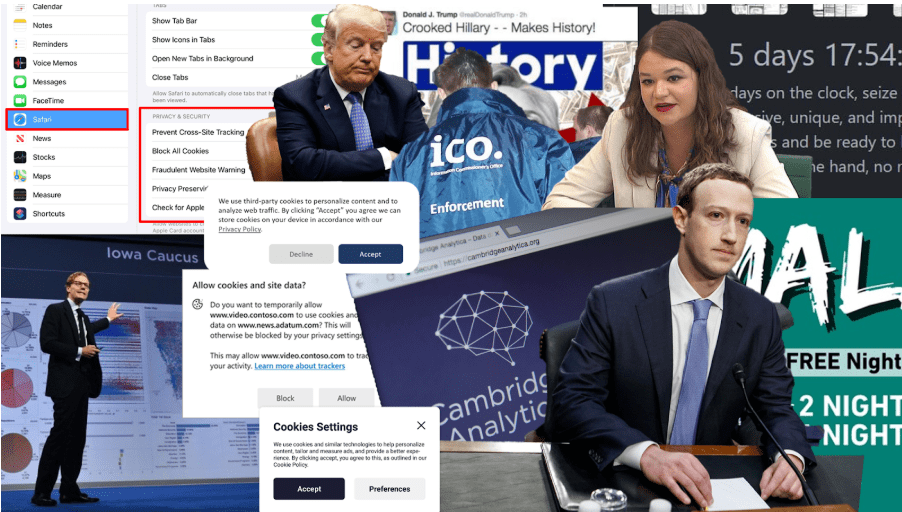
    Hyper-targeted ads may seem rather unthreatening, with the only tangible consequences being felt by your bank account (my overdraft is screaming!). However this isn’t the whole truth. Data, although it seems like it only has online consequences, could be sending us further and further into the Matrix hand-in-hand with Keanu. We saw this with Cambridge Analytica’s involvement in the 2016 US Election and later in the Brexit Campaign in 2018. Cambridge Analytica was a political consulting firm specialising in using data to push their client’s political campaigns. Alexander Nix, the father of Cambridge Analytica, claimed to have 5000 data points on every US Voter. When helping push Trump into presidency, Cambridge Analytica didn’t target every US Voter (a problem that safely lies 25-or-so years ahead of us, fingers crossed), instead, they used data to build a psychological profile and then target persuadable voters through psychographic online microtargeting. A mouthful, I know. To fall into the category of ‘persuadable’ you must fulfil one of the Big Five personality profiles: agreeable, open to new experiences, extroverted, neurotic, or conscientious. Psychological researchers have shown that the things we “like” on platforms like Facebook can be used to predict our personality traits. Like + Cat meme = agreeable. 

    So, follow the programme:

    1. Find persuadable personalities through psychographic microtargeting based on data profiles
    2. Send them advertisements like fake Facebook ads 
    3. Then you’ve made just enough change to sway the polls in your favour

    Project Alamo, the online division of the Trump campaign under the direction of Cambridge Analytica, spent around $1M a day on Facebook ads, pushing the “Crooked Hillary” narrative. Fake news was used again for the Brexit agenda following Analytica’s (short-lived) success. 

    Yes, it is rather gloomy and dark. But before you run off and delete every social media account you have ever made and change every password in the hopes that you will remain off-grid forever, let me relay some reassuring news. What Cambridge Analytica highlighted through their ability to incite real political change was the need for data rights to be covered by human rights (in the meantime, all that was sacrificed was modern democracy). We need transparency with how our data is being used because it is our property. Data rights are human rights. In this tempest of data advances, navigating this 3D digital chess board depends on our defences. We can prosper as a computer chip in the digital age through an education on data rights and restrictions. 

    Technology can make a huge difference and will for many years to come, but it’s how we let it define us that is the big question. So, before you gobble up those  cookies or accept those privacy policies, take a moment to pause. Google is free, use it to educate yourself. Brittney Kaizer (@own.your.data), a Cambridge Analytica whistleblower, saw the light and is now a data rights activist working with the UK Parliament to improve our data rights. 

    The battle against cyberware is a long and arduous one. Take Dave Carrol. Following Cambridge Analytica’s bragging about data stealing for Trump, he embarked on the quest to retrieve his data and is still engaged in the legal battle. Cambridge Analytica was the lightning rod for a confluence of feelings about Trump’s election, Facebook, Brexit and the rising use of data modelling as psychological warfare. But it is bigger than just Cambridge Analytica. That big bad wolf may be gone but there are others out there and we must make it through the woods, red cape and all. 

    Carrol won’t stop until he gets his data back because it means more than just him,

    “All I want is everything, because I’m entitled to it. And so is everyone.”

    https://www.pnas.org/doi/10.1073/pnas.1218772110#ref-15

  • GUM X READER

    GUM X READER

    CW: SMUT

    He bites his lip and his eyes darken…

    ‘Y/N, don’t look at me with those eyes.’

    ‘What are you going to do about it?’

    He stalks towards me and places his hand on my cheek. His digits run across my face and then he-

    ‘DINNER TIME!’

    Dirty stories found on AO3, Wattpad, Tumblr (the holy trinity) featuring favoured fictional hunks have become a significant part of the hormonal sexual awakening. Wattpad has around 90 million monthly users and over 665 million stories. “Revolutionary” works by ‘great novelists’, i.e. old white men, pale in comparison to the pen[wo]manship of middle school girls. Her dog is ill, she’s moving house, and her parents are divorcing during exam season and yet, she’s created a masterpiece. 

    Can Shakespeare say the same?

    Often following trends, such as the ever-evolving “White boy of the Month” on TikTok, or catalysed by new films or series, recently it’s The Ballad of Songbirds and Snakes or House of the Dragon, these stories elicit millions of readers. Most are completely unhinged sexy romps, à la After, that go on to be made into equally cringey movie adaptations. These variations on traditionally formatted video porn are at times comically cringey, hot asf, or genuinely concerning, as real world people are often slowly roped into the narrative. The result? Most teenage girls not blinking an eye to the ‘scandalous’ Saltburn, having read much worse. Regardless, smut of all forms can be an entirely valid avenue to climax.

    Fanfics and smut are mostly written and consumed by young women. A common joke online is that smut readers need to assign a designated individual to delete their reading history upon their death, taking their scandalous smutty vices to the grave. Smut is so popular due to the taboo of female sexuality. At school I remember boys openly talking about their favourite porno (a troubling thought then and now, ugh!). It was an unspoken truth that if their female peers mentioned anything of this ilk, public ridicule would have ensued.

    The increasing objectification of the women in porn is off-putting. How does one find pleasure in something that fails to keep your perspective in mind? Fanfiction does just this: it reallocates humanity and identity in sexuality. There’s no worry of hackers or viruses, and it is completely free. Only an ad for ‘Mistplay’ between chapters on Wattpad. It is customisable through tags and the genius design of AO3. Choose your man, trope, length, and rating. 

    It gives us a vivid space for escapism. In an age where misogyny is on the rise due to the cretins of the internet like Andrew Tate, teenage boys can be repulsive. So log on to Wattpad and be with a respectful beefy superhero who is in love with you. Watch edits of your man and evade being tied down; on the internet you can have multiple boyfriends. It’s a community space happily centred around celeb obsession and disrupting the taboos of female sexuality. While female interests are ridiculed by men on podcasts, these spaces become safe havens. The comment section on Wattpad will forever be the funniest place on the internet. 

    Still, fanfics remain the bastard of the literary family. They dominate the debate of High Art and true literature; the erotica of Nabokov is allowed but not mine, why? ‘Respectable’ modern-day literature has no shortage of derivative works: Tom Stoppard’s Rosencrantz & Guildenstern Are Dead or John Updike’s Gertrude and Claudius are Hamlet fanfics. Pamela Morgen’s series based on Pride and Prejudice was acquired by Simon & Schuster and is widely cited as a fanfic author crossing over into “real” publishing. Yet no one slapped the fanfic label on Sally Beauman’s Rebecca’s Tale, a retelling of Daphne du Maurier’s Rebecca, when it was released by a major publisher in 2001.

    In 2020 a tumblr post went viral. It described the link between – wait for it – 9/11 and Fifty Shades of Grey, illustrating the significance of fanfiction in mainstream media. Catalysed by Gerard Way, lead singer of My Chemical Romance who formed the band post witnessing 9/11. MCR’s music inspired Stephanie Meyers to write the Twilight saga, a self-insert vampire angst filled slow burn romance. The Fifty Shades trilogy was developed from a Twilight fan fiction series originally titled Master of the Universe and published on fanfiction websites by ‘Snowqueen Icedragon’. Full of BDSM, slowburn angsty smut, it leaked into Hollywood and the homes of millions around the world in a “respectable” fashion. 

    Fanfiction is a symbol of teenage female sexuality that, after being shamed by society for decades, has now found sanctity on the internet. Fanfiction is all around us whether you like it or not.

    But I do and so do millions around the world.

  • PERSCRIPTION FOR EQUITY

    PERSCRIPTION FOR EQUITY

    What are girls made of? Hormones, Hysteria And everything nice…

    Embarking on the journey through the man-made medical maze is a daunting challenge for many women; there is an undeniable history of perpetual misunderstanding, mystification, and misdiagnosis of women’s health issues. Harking back to the wandering womb in ancient greek medical texts, the Salem witch trials, and the days of “feminine hysteria”, and now to menopause, endometriosis, and postpartum depression. The etymology of hysteria” is derived from the Greek word ‘hystera’, literally translating to uterus, reinforcing the misogynistic reduction of women and their wellbeing to their reproductive organs. There is a medical orthodoxy masking a horde of misdiagnosis and misconduct cases from male physicians and psychiatrists, creating a vast gender-based disparity in health research and treatment affecting millions of women across the world. 

    The UK is thought to have the largest female health gap of all G20 countries with millions of women falling through it annually. According to the new digital healthcare service Livi, ‘over half of UK women fear they’ve been misdiagnosed at least once in their lives, with a quarter believing this is due to ‘simply being a woman’. The knowledge surrounding the differing effects of illness in men and women are unknown. The symptoms of a heart attack or stroke appear differently in women than they do men. The main conditions with severe, prolonged and debilitating symptoms such as PCOS, chronic pain, and endometriosis are woefully under-researched. But what we do know is that women are experiencing institutional scale medical misogyny.

    PCOS, or polycystic ovary syndrome, affects  roughly 10% of women at reproductive age in the UK and causes fertility issues nationally. It can take up to 8 years to receive a diagnosis of endometriosis, a devastatingly haunting statistic, actively discouraging me from exploring the condition myself. Endometriosis is a chronic gynological disease where tissue similar to womb tissue grows around the body causing severe symptoms: infertility, fatigue, and period, pelvic and chronic pain. Endometriosis occurs in 4 stages, as it worsens it increases the difficulty to treat; this impact cannot be understated. 

    The organisation Chronic Illness Inclusion represents disabled women, like myself, who report recounts of ‘gaslighting’ and ‘accusations of hysteria’ by medical professionals in examples of gender and disability prejudice. They’ve received more than 800 complaints of negative healthcare experiences of disabled women with energy-limiting chronic illness and pain. Chronic pain is prevalent in 34% of the population, but reportedly significantly higher in women. For these cases of chronic pain, the most common treatment is prescription opioids which are disproportionately prescribed to men not women. So women must turn to over the counter medication. 

    Let’s take Feminax, a period painkiller, 1 pack includes 16 tablets at £5.49. With severe pain, one may need to take up to 2 tablets every 4 hours, totalling at 12 tablets every 24 hours. For a whole week, the average cycle of a period, that’s nearly 6 packets costing around £33. Annually, this totals at £400 to medicate just one week, every month. Not accounting for any muscular, neurological, or other illness. To self-medicate period pain for 10 years you could find yourself spending over £4,000 just to get through one week of the month. Issues like the pink tax don’t help this issue and create comercial economic misogyny. Feminax is 346 mg of Ibuprofen Lysine and targets women with its little pink box. However, migraine relief is the same medication sold for a fraction of the price at  £2.15. Women are continually misled with this information, encouraging them to spend thousands of pounds on, essentially, a pharmaceutical scam. 


    All these symptoms of misinformation, negligence and simple misogyny lead to a bleak and horrific terminal diagnosis. I myself can, reliably, diagnose the UK with a callous case of terminal gender healthcare disparity. The NHS is infected. But this isn’t new. It traces back to Aristotle’s distinction between the superior male “form” and inferior female “matter”. Even Aristotle’s argument is fundamentally wrong and has been heavily disproven. The significance of this idea catalysed centuries of suffering for millions of women.

    I must admit, while writing this I’m boiling with rage, frantically typing while listening to A Pearl by Mitski on a meticulously curated female rage playlist’. 

    Consider my fuse blisteringly burning…

    But the truth I must sadly reveal to you is, I don’t have the answers; the miracle antidote to fix this festering and violent cancer that has infected our healthcare system to the core. But that shouldn’t be my responsibility. Healthcare is a basic human right that I shouldn’t fear or doubt. I want to be heard and respected. I’m not being a bitch, I’m being a fucking person. Women are people. And I will scream, shout, yell, and belt until you hear me and help us.