In the twentieth century, queer individuals faced a diverse array of social, legal, and cultural challenges. Homosexuality remained criminalized well into the century—in the UK until 1967—and queer representation in public discourse was often met with censorship or moral panic. The 1970s and ’80s saw the emergence of radical LGBTQ+ activism, such as the Gay Liberation Front and ACT UP, pushing for visibility, rights, and systemic change. These movements were catalysed by the AIDS crisis of the 1980s, which disproportionately affected gay men and laid bare the neglect, stigma, and structural violence faced by queer communities.
Against this backdrop, queer artists used visual culture to contest marginalization and to articulate identity and belonging. As Eve Kosofsky Sedgwick argues in Epistemology of the Closet, queer subjectivity is shaped through mechanisms of concealment, silence, and resistance. Many queer artists navigated these tensions by embedding coded meanings, psychological depth, and activist intentions into their work. This paper explores how Francis Bacon, David Wojnarowicz, and Catherine Opie used their practices to reflect the evolving concerns of queer life—from repression and grief to affirmation and community.
Wojnarowicz, an American multimedia artist and outspoken activist, exemplified the use of art as political resistance. Informed by personal experience and a broader context of systemic neglect during the AIDS crisis, Wojnarowicz’s work often blurred autobiography with activism. His piece Untitled (One Day This Kid…) (1990) positions a childhood image of the artist surrounded by declarative text detailing the persecution and trauma queer youth face. The text operates as what Judith Butler might describe as a counter-discourse—reclaiming the power to name and grieve lives otherwise considered “ungrievable.” The piece highlights the socio-political forces that shape queer life from an early age and critiques the silence of institutions during the AIDS epidemic. Wojnarowicz’s work foregrounds what Sedgwick identifies as the need to make queer suffering visible, not as spectacle, but as a demand for justice and dignity. His art functions as both memorial and protest, reclaiming queer presence in a public sphere that often erased it.
Francis Bacon’s work communicates queer identity through a visual language of distortion, isolation, and psychological intensity. Working in mid-century Britain, where homosexuality was criminalized until the Sexual Offences Act of 1967, Bacon developed a uniquely visceral style that captured the existential toll of repression. In Two Figures (1953), Bacon paints two male bodies in a contorted embrace, their forms blurring the line between intimacy and struggle. The figures are framed within cage-like enclosures, echoing what queer theorists describe as the spatial and psychic constraints of the “closet.” While Bacon rarely addressed his sexuality publicly, his work, as Sedgwick might note, “says” queer without “naming” it—embodying what she calls the performative ambiguity of queer existence. His paintings expose the instability of desire, shame, and identity, reflecting how queerness, in the mid-century context, was often internalized rather than externalized.
Catherine Opie brought lesbian identity to the forefront through her photography challenging both heteronormative conventions and internal community stereotypes. In Self-Portrait/Cutting (1994), Opie presents her back with an image of a lesbian family carved into the skin—a raw metaphor for the pain and longing for inclusion in traditional family narratives. The work visually articulates the violence of exclusion while asserting a vision of queer domesticity. Opie’s series Being and Having (1991), features lesbians styled in hypermasculine drag, deliberately subverts gender binaries, echoing Judith Butler’s theory of gender performativity. Opie’s photographic practice offers an archive of lesbianism presence—centred not on trauma, but on community, visibility, and care. Her work resists the notion of a “single story” of queerness by showcasing its multiplicity.
Through their distinctive approaches—Wojnarowicz’s confrontational activism, Bacon’s psychological introspection, and Opie’s intimate visibility—these artists critically reflect the shifting issues central to queer lives in the twentieth century. Their work engages with themes explored in queer theory: the performative nature of gender, the constraints of the closet, and the politics of mourning and recognition. Collectively, they underscore how queer art became not just a mode of self-expression, but a potent strategy for resistance, redefinition, and survival in a world that often sought to erase them.
Universities pride themselves on legacy. It is what leads us to the institution, its name. The buildings housing our education are built honouring the alumni of our great establishment. Dates, crests, latin and lists of old white men’s names litter the five hundred and seventy three year old walls, reminding us of the people behind the University of Glasgow. But what about the money behind these institutions, not just the people. The flowing river of cash converted into salaries, scholarships and study spaces. The investment of funds into armstrading and the weapons industry has been a hot topic on campus for the last decade. It seems obscene to think that the money from our humble scholastic sanctuary put a gun in the hand of an IDF soldier or helped build a fighter jet “mowing the lawn” of the Gaza strip.
Or is it?
Let’s go step by step:
1.You pay your fees to the University of Glasgow, around £9,250 for the average UK student
2. A fund manager from the Investment Advisory Committees invests in stock market categories, for example in the Arms Category, BAE systems. In 2024 the university bought 14,998 shares with a market value of £194,524.06.
3. BAE produces the rear fuselage, used in F-35 fighter jets. that are produced by Lockheed and Martin, whom in 2024 the university bought 855 shares with a market value of £360,731.52
4. The Israeli Government, buys 50 F-35 jets, receiving 32 by 2022. The UK Defence Minister admitted that ‘there were 14 transfers of F-35 components’ from the UK to Israel between 2023 – 2024.’
5. The stock price of BAE increases, BAE Systems prices have soared by almost 120% across the last 3 years following the war in: Ukraine, Palestine and Yemen.
6. The F-35’s are used on the air strikes of the Gaza strip, killing more than 46,000 Palestinians
7. BAE makes a profit from the IDF’s purchase, before interest and tax in 2023, BAE made a record sale of £25.3bn.
8. UOG sees a return on their investment by the continuation of endowments from BAE, in 2023 UOG had 17,075 shares at £159,045.86 continuing into 2024. BAE have £38,879,098 in research partnerships with UOG
9. I get my £1000 a year RUK Scholarship.
Unfortunately, the F-35 jet isn’t the odd exception.
From the companies UOG invested in both in 2023 and 2024, they produce parts or manufacture the: F-161 jet, BAE makes the HUD (Head up Displays), MK 38 Mod 2 machine gun by BAE , F-35A jet manufactured by Lockheed and Martin or the F-35B-C jet manufactured by Rolls Royce. Or even the software for the Heron Medium-Altitude Long-Endurance UAV drones by Thales.
Just to name a microscopic portion of the Israeli arsenal produced by companies in UOG’s investment list.
In 2009 to ensure the university was making ‘socially responsible investments’ it introduced its SRI policy. Ensuring all investments were aligned to the UOG’s “world changing views”, in the interest of ‘environmental and social governance’. This ‘ethical investment service’ was a facade, a smoke screen of political correctness to cover the millions of pounds that our university has fed into the arms trade.
Following a blockade of the Rankine Building by GUJPS and GAFF on the 12/3/2025, a liaison meeting with the Chief Operating Officer, David Duncan and Head of Security Gary Stephen was arranged:
One last question from myself-
DD Go on.
Do you acknowledge that the university makes money from killing people? From war. Do you acknowledge that fact?
DD No. No. It’s not true.
Are you sure David?
The University Fund managers are ‘required to divest from companies that seriously breach international treaties that the UK is a signatory of’.
In the 2024 investments, Caterpillar Inc (1,469 shares at £397,070.89) are alleged to be providing equipment used in the demolition of homes in conflict zones, leading to displacement. This violates the Universal Declaration of Human Rights ‘Article 12: protection against arbitrary interference with one’s home’ and ‘Article 17: right to property ownership’. Alstom SA (2,785 shares at £42,514.16) are alleged to be involved in Israeli settlement projects in Palestinian territories, actively displacing communities. This violates ‘Article 9: protection against arbitrary exile’ and ‘Article 17’. Both the Israeli banks, Bank Hapoalim (3,904 shares at £28,073.09) and Bank Leumi (4,737 shares at £32,003.99) were identified by the High Council for Human Rights, to be ‘involved in the activities’ aiding the ‘Israeli settlements’ on ‘occupied Palestinian Territory’.
This identifies some of the investments that have breached Human Rights, unrelated to the arms trade. The supplement of arms to states at risk is a clear breach of Human Rights, clearly not.
GUJPS/GAAF calculated that in 2023 the sum of arms investments by UOG was at £4,493,821. In addition to this, the University’s careers service platforms these companies, inviting them to careers fairs. There are 23 active research grants, totalling around £60,343,849, funded by arms companies in the Engineering (~£23,093,465), Physics (~£26,249,593), Astronomy, Chemistry, Computing Science and Math & Stats schools. These are funded by Thales (389 shares at £48,158.10), Leonardo (3.297 shares at £61,134.90), Honeywell (1,843 shares at £293,786.64), Lockheed and Martin, BAE, Airbus (1,585 shares at £186,888.85), Dassault, Jacobs, QinetiQ, Siemens and Teledyne.
All are known to have made contributions to the Israeli Defence Force.
A FOI request was sent to UOG to ensure the 2024 File of Investments held for Endowment would be made publically available. They were released for a few days when they were taken down and were only recently reinstated.
110 of the 1038 companies we define as ‘socially irresponsible’.
David Duncan defined a moral ‘distinction’ in ‘a defence sector’ and the sales of ‘arms to certain recipients’.
So what you are saying about, companies who’ve- there is a difference between having a defense sector and-
DD selling arms-
-dealing arms to certain people, certain countries-
DD Yep.
-in high risk states. So PAX, a peace charity, used data from the Stockholm International Peace Research Institute to look at the unethical deliverance of arms to states at risk by the 25 largest arms companies [Lockheed Martin, Raytheon (now RTX), Boeing, Northrop Grumman, General Dynamics, BAE Systems, AVIC, L3Harris, Airbus, Leonardo, Thales, Honeywell, Rolls-Royce, General Electric and Safran]. In the companies identified [by PAX] bar 1 [AVIC] we have investments in all of these companies in both 2023 and 2024 [totalling at an estimated £2,896,094.39 in 2024]. And then they also looked at the links between the 15 biggest European banks who continued loans and investments with these arms companies in light of their unethical arms trading who through sales “contributed to negative human rights impacts”. So what you’re saying people delivering arms to people who are actively, the unethical deliverance of arms in differentiation from a defence sector. Out of the banks, out of the top 15 banks who engaged in that, we have investments in 10 of them.
DD So your talking about banks rather than defence sector-
Banks who continued to support arms companies and the arms companies themselves who did exactly what you are saying is unethical, supplying them to certain states at risk, so we have done that.
DD Yeah.
With the The companies highlighted were done through the 10% rule, as long as the company makes less than 10% of its profits from arms trading, all is ok.
We haven’t. Murder is Murder. Whether in Yemen, Palestine or Sudan. Be it a bolt, a nut or a screw, complicity in the production of any part in the machine of war is unacceptable.
Overall, the sum of arms investments in 2024 is estimated around £4,520,625.29.
David Duncan said a ‘revised SRI policy’ would return to the University Court in April of 2025. Judging from the ignorance to genocide by the managerial team surrounding the issue of divestment, what does this mean for the student body as we sit and wait?
To be bigger, louder and stronger. To stand together with the UCU, SRC and the greater Glasgow community. As said by Chomsky and Pappé, ‘We are many. We will prevail’.
Success has been seen previously. Student action directly led to the divestment of university funds from the fossil fuel industry, however pathetically that has been pursued by the Investment Advisory Committee.
The prevalent presence of student activism on campus highlights the problematic funding that goes into building a university, book by book.
Our university is built on the back of colonial profits and we now see the game of apologetic amendments unfolding. In 2016, UOG acknowledged it ‘received some gifts’ ‘from persons who may have benefitted from the proceeds of slavery’. In 2018, UOG announced a set of initiatives acknowledging its colonial past. In 2019, they signed an agreement with the University of the West Indies in Jamaica pledging £20 million in funding activities relating to restorative justice and the issue of slavery.
Amendments can be made and divestments done without the bankruptcy of the university that is so greatly feared .
If David Duncan and the rest of the faceless, nameless, cowardly UOG management cannot open their eyes to the humanitarian crisis we are actively contributing to and not divest, should we?
If only it was that simple. To remove our fees, return our scholarship removing the fear of indifference to the economic contribution to war. As students, we now have to define our alignment with the university system in the 21st Century. The access to education builds the tools to challenge the colonial capitalist ideology plaguing not just the halls of the GUU but the foundations of the world.
Education is not the cost to be cut. It is the investment in the arms trade.
Simple, right David?
Management’s choice to not divest illustrates the hypocrisy at the core of the University of Glasgow, not by the student body but by its perverse pedagogues.
So, you joined us. We followed these funds down and you saw what we found. Now it falls to you. Engaging with the issue of Palestinian liberation or any war is to engage with divestment and that begins in this university we call home.
We can only show you the way, tell you the truth, you must help create the life we all deserve.
‘They murdered Valjean, when they chained me and left me for dead, just for stealing a mouthful of bread’ – Les Miserables
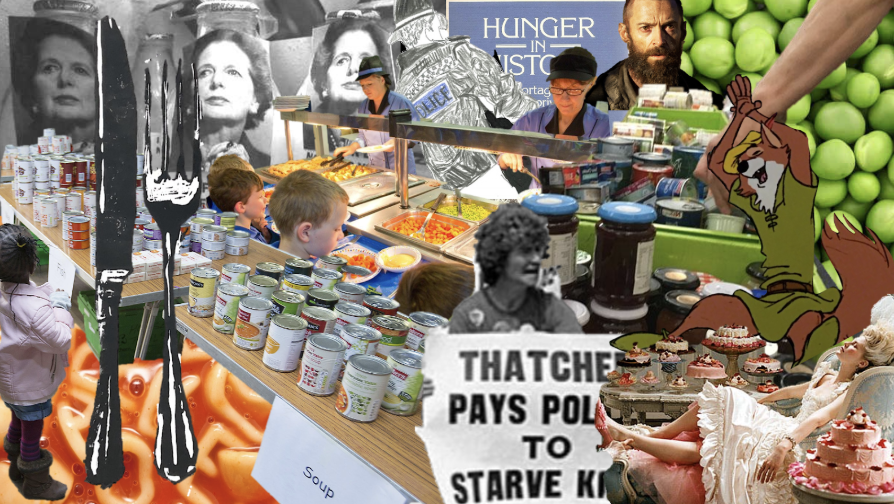
To live in 21st century Britain is to live in a country with security tags on butter and cheese, and three million children living in food insecurity.
It is a common omen to see the cardboard policeman looming over you while doing the weekly shop. The cameras in the corner hoping to catch you slipping a steak in your shopping bag. Stealing and shoplifting is on the rise, 2023 was the worst year on record for shoplifting. There were more than 430,000 cases recorded, an increase of more than a third from previous years. This only accounts for the ones who were caught, the more sophisticated smugglers were more discreet. In the heat of this ever rising cost of living crisis, we are more willing to pocket an item or conveniently “forget” to scan it.
But how did we get here? How did the legendary heroic outlaw figure of Robin Hood shift from an English folk story to a disney fox best pals with a monk/bear, to us, the common people?
Food as means of a currency has always been weaponized against people in societies. Access to simple human needs like food, water and housing has formed the basis of political movements and ideologies, its giving socialism. Our human hunger is universal, it reaches the furthest corner of the world. It made Peeta give Katniss a piece of bread, Mr Scrooge buying the prize turkey for the Cratchits and Marie Anoinette saying ‘let them eat cake’.
Hunger is a chronic problem across human history that has become amplified through its integral relation to the capitalist system of commodification. The ruling class is able to create a ‘food regime’ focusing on: production, distribution and consumption. The Universal Declaration of Human Rights in 1948 recognized the right to food as part of the right to an adequate standard of living. Marx wrote, ‘all labour, is originally first directed towards the appropriation and production of food’- straight bars. So as a society why must we shoplift in as a means to satiate our starvation?
As to many of the problems at the heart of British society, in my humble (and Northern) opinion, this can be traced back to the witch herself: Margaret Thatcher a.k.a Thatcher the milk snatcher.
Let’s rewind. Under the Liberal administrations of 1906-1914, the British Parliament started off with a bang and passed the Education (Provision of Meals) Act. Allowing Local Education Authorities to provide free meals to elementary schoolchildren, funded out of the local rates. In 1921 – this was extended to free milk. A third of a pint of milk a day for every child in school was a simple, effective way to counter the worst effects of malnutrition caused by wartime rationing. In 1937, Glasgow’s very own John Boyd Orr revealed that there was a link between low-income, malnutrition and under-achievement in schools. Ellen Wilkinson, the first female Minister of Education in Britain saw the Free Milk Act into law in 1946. Slay.
UNTIL, Big T enters the scene. As Secretary of State for Education and Science in 1970, Big old Thatcher decided, why do children need protection from the government from malnourishment? Original thought. In the 1970s Food banks were unheard of in the UK. Hunger has risen under the following Tory Governments following Thatcher the milk snatcher. Britons going hungry have been forced to become food bank users instead. The Trussell Trust, one of the leading food bank charities now has over 2,500 operations across the UK. In the midst of this, enters Dishy Rishi. During Sunak’s tenure as chancellor, wild to think he became prime minister (crazy pipeline) over 21 million pounds was lost to fraud, an underestimation of the true amount lost and over three times preceding years of Tory Governments. Nice one Rishi.
Our plates and portions have slowly lessened, yet contrary to Conservative beliefs this doesn’t affect our hunger. The effects of food poverty have detrimental consequences both physically and socially. Bang on Boyd. Under the Tory Governments there has been a shift in the nature of poverty;gone are the days of a gorging monarch having fancy dinner parties, apple in the hogs mouth and all. Now it is the very Government supposed to be protecting the people who are starving them, one singular act can impact the appetite of our great nation. Across the 24,253 schools across the UK educating around 9 million pupils, around 25% need free school meals. That’s around 2.1 million of our darling nation’s children.
So as dinner time creeps slowly closer and there are hungry mouths waiting to be fed, what is to be done? Being “hangry” is real.
As a society, not just in our very “un-great” Britain, we must find a means of satiating our appetites through collectivism not individualism, feeding the people around the table as well. The capitalist commodification of our appetites has pushed us into over gorging, canning and stockpiling. One shouldn’t have to read Das Kapital from cover to cover to understand the importance of having access to the fuels of our physical fires. The Government and administrative bodies, within any country, should be catering and serving up this social satiation.
The post-Halloweekend scroll through TikTok or Instagram is always fun. Seeing costumes from super niche to mainstream – the aftermath of Halloween reigns supreme to the night.
But the persistence of misogyny and the male gaze has always spoilt horror films and Halloween for me. The genre seems to be a boiling point of ultra-graphic and violent misogyny under the guise of “artistic greatness” and “creative freedom”. Think Micheal Goi’s obscene and unnecessary barrel scene in Megan is Missing that adds nothing to the plot or the ending of Darren Aronofsky’s Mother! (That is too traumatic to touch on). The “boy’s club” of horror combined with the unspoken demand for sexiness and skimp on Halloween night, this year made me feel inadequate with my Trinity costume while queuing for the club next to a Victoria’s Secret Angel and a Sexy Pirate.
This combination of the fantasy of film and sexualisation is a synthesis of women and commodity: the brotherhood of capitalism and the patriarchy’s greatest desire. To reduce women to a machine, a part to be played, a costume to be worn. The thematic prevalence of the “perfect female” is a fantasy ingrained into our collective consciousness through mainstream pop culture. Many horror films position the viewer as a heterosexual male, which perpetuates reality. The genius theorist Laura Mulvey explains how ‘women exist in film to symbolise a lack,’ becoming the ‘bearer of meaning’ but never the ‘maker of meaning’. The image of the woman is thus raw material for men to look at and serves as an erotic object, both for the male characters within the film and for the spectators of the film itself.
When girls treat their boyfriend by purchasing a maid costume, NPC live streams as “The Perfect Anime Girl”, or edits of Joi from Blade Runner are all examples of this. A sexy nurse, sexy policewoman, sexy Lara Croft, or sexy princess Leia in the infamous Jabba the Hutt slave costume. These costumes all ignore the stripping, dismembering, mutilating, and disrespect shown towards the characters they emulate from film and reduce women to their idealised, primary function in the patriarchal capitalist utopia: sex. While women are entitled to dress as they please, it is naive to ignore that Halloween has been marketed to us as a night of the taboo where these ideals can briefly come to a head.
On a seemingly innocent night of fancy dress like Halloween, by breaking the fourth wall and bringing these ideals IRL, a dilemma is caused that cannot be understated. In a climate of rising misogyny and fringe gender ideals creeping into the mainstream (thanks Andrew Tate), something simple and fun like Halloween could have dire consequences. According to a study conducted for The Independent, 55% of men in the UK believed that ‘the more revealing the clothes a woman wears, the more likely it is that she will be harassed or assaulted.’ Halloween is a time that makes hiding one’s identity socially acceptable thanks to masks that obscure it, like the infamous Ghostface Mask from the 1996 film Scream. Through this “promise” of namelessness, it makes perpetrators feel uninhibited by the usual social standards of behaviour and increases the likelihood of them committing a crime.
However, hope is not completely lost in the sea of fetishisation and violence. When scrolling through my feed this Halloween, I saw an increase of deranged females being emulated and the reaction they provoked in the comments of unapproving teenage boys gave a brilliant insight into the view of femininity in the 21st century. I found this correlated with the rise in the “female rage” and “good for her” sub-genres of horror films. I’m sure your FYP is flooded with the deafening screaming edits of Cersei Lannister and Taraji P. Henson in Hidden Figures’ “working like a dog!” scene, backed with Mitski or Lana Del Rey.
On Halloween, you can enter the hall of enraged, destructive women next to all-stars Jennifer Check, Nancy Downs, and Red. The choice of a costume is evolving from “dressing up” to being a radical act of resistance. Even by being an “anti-cool girl”, going silly by being Georgia as an Olive in Angus, Thongs and Perfect Snogging, or Wallace from Wallace and Gromit, complete with bald cap and cheese. Ranging from Chloë Sevigny’s iconic depiction of Joan of Arc with her Walkman, or feminist pagan poster girl Circe from the Odyssey, to a psycho ex-girlfriend like Lillith or Amy Dune. The multifarious aura surrounding feminine figures in film, literature and culture – whether fierce, striking, innovative or straight-up hell-bent – can emerge at Halloween and stay with you into the following months, and then years…
Since the dawn of humanity, the Cambrian explosion wasn’t the only evolutionary burst of life to report. As we explored the world around us, we quickly began to utilise it to bring us closer to sexual gratification. The history of sex toys reaches much further back in time than the utilisation of technology in our never-ending quest for stimulation. From Victorian-era steam-powered dildos to hand-cracked vibration devices, and the famous Hitachi Magic Wand to the more modern devices with Bluetooth control leaving a throbbing memory. Who would have thought a little pink bullet could possess years of breathtaking lore, while also being a symbol of the politics of female sexuality and the perpetrator of good vibrations.
This stimulating history stretches back 30,000 years to the Palaeolithic period. A siltstone phallus was found in Germany and is said to date back 28,000 years, making it the oldest known ‘sex toy’ ever discovered. Our Palaeolithic pals really got creative with it. Phalluses made from stone, wood, leather, and even camel dung have all been found during excavations. The Egyptians and the Greeks used unripe bananas, or animal dung coated in resin as sexual aids believing them to be aphrodisiacs, a substance alleged to increase libido.
Some say that the Egyptian queen Cleopatra invented the first vibrator in history. She had the idea of filling a box with bees (no mid-wank-battery-dying for her – simply shake and go) and the violent buzzing caused the box to vibrate and then… Well, the rest is history. Cleopatra’s saucy secret gave a new meaning to the status of “queen bee”, and she really put those bees to work. Despite her box remaining shrouded in mystery, Cleo nonetheless remains an Empire-ruling, pearl-eating, vibrator-creating Baddie.
RIP Cleopatra, you would have loved Sexyy Red and LoveHoney.com.
In ancient Greece, traders in the city of Miletus reported the making and selling of objects called ‘olisbos’, created to help wives achieve sexual penetration while their husbands were away. Nowadays, for a mere £40 you can ‘Clone a Willy’ for your night-time itches (I wonder what the rate of inflation for such devices is). History has proven that absence makes the pussy grow horny, I guess women never change.
These types of aids were also used in Renaissance Italy, typically made of leather and doused in olive oil for lubrication. High class members of society would even display their sex toys, often made from silver, gold, and ivory. Picture this: you walk into your neighbours house and compliment them on their ‘ever-so-thrilling’ mantle piece adorned with metal appendices in the place of flowers or candles.
The first dildos didn’t arrive in the UK until the 1500s. The term dildo was first coined in around 1400 AD and originated from the Latin for ‘dilatare’, meaning ‘open wide’. Up until the 1920s, vibrators were used among physicians to ‘massage’ female patients into an orgasm in order to treat them of ‘hysteria’. A devastating, life-threatening, earth-shattering condition that has been recently denominated,
drumroll please…
‘Female pleasure’: an ailment considered both common and chronic among women.
Enter: Dr. Macaura’s ‘Pulsocon Hand Crank’ from 1890 (the name alone is as scary as an angry beehive). Apart from being hand-cranked, the mechanics and effectiveness of this Victorian Era device are unknown, and I, personally, am content with such ignorance.‘The Manipulator’ (I know) was another vibrating Victorian favourite, and this steam powered beast was apparently as powerful as it was noisy.
‘Honey, what’s taking so long in the bathroom?’
Full steam-spunking power from Level One to Eleven.
In 1970 there were fanny-flutters all round as the famous Hitachi Magic Wand entered the market. An MVP in the sex toy world, the GOAT, the Micheal Jordan. Sex Toy Experts say that it is, still to this day, the best plugged vibrator in existence. Imagine 110 volts of alternating currents being transformed into a massive rotating and vibrating power ball of pleasure.
What is pink, nine-inches long, twirls, flutters and vibrates, and is known for its disarmingly cute bunny ears? ‘The Rabbit’. This vibrator catapulted to fame 20 years ago when it featured on Sex and the City. It became a pop culture sensation and Kim Kattrell single handedly ushered in a new era of sexual consumerism. Thank you Samatha Jones, we are eternally grateful to you. For the first time, female shoppers boldly strutted into sex-toy stores. ‘The Rabbit’ became an instant classic and Sex and the City took vibrators out of the shadows. No need to be plugged in; just a couple of triple AA’s and lift off!
Nowadays, the sex toy represents autonomy and allows for self-exploration. They are a pink, jiggling symbol of liberation, particularly for women, given the turbulent history of the shaming of female sexuality. The androcentrism of sexuality and typical heterosexual intercourse has created a vast orgasm gap: the marked difference in the frequency of orgasm between cisgender men and women in intercourse. This has pushed women into finding their own pleasure, and toys lend a buzzing helping hand (or member). Post COVID, like Renaissance Italians, we are embracing a new age of sexual pride in our toys. When showing ‘What’s in my bag’ to British Vogue, Emma Corin nonchalantly whips out a little pink lipstick-looking gadget and plainly states ‘my vibrator’. Charlotte York gleefully explained their charming significance: “Oh, it’s so cute! I thought it would be scary and weird, but it isn’t. It’s pink! For girls!”.
As of a 2021 report by strategy&, the global sexual wellness market is estimated to be worth over $19 billion. The market (rather unsurprisingly) grew by 36.8% over COVID-19 and the forecast for the market is to keep thrusting forward by 7% annually. The popularity of vibrators and dildos has endured since the Roman era, as they account for 27% and 25% of the global market In the UK. You can buy them online at ASOS, Urban outfitters, or Boots to be delivered right to your doorstep (thank me later).
Gone are the times for a painful and humiliating trip to Ann Summers and cluelessly buying the first thing you see in an attempt to be in and out as quickly as possible. Now, just one click and bzzzzzzz… bring on the Good Vibrations!







 Swan Soul Stories